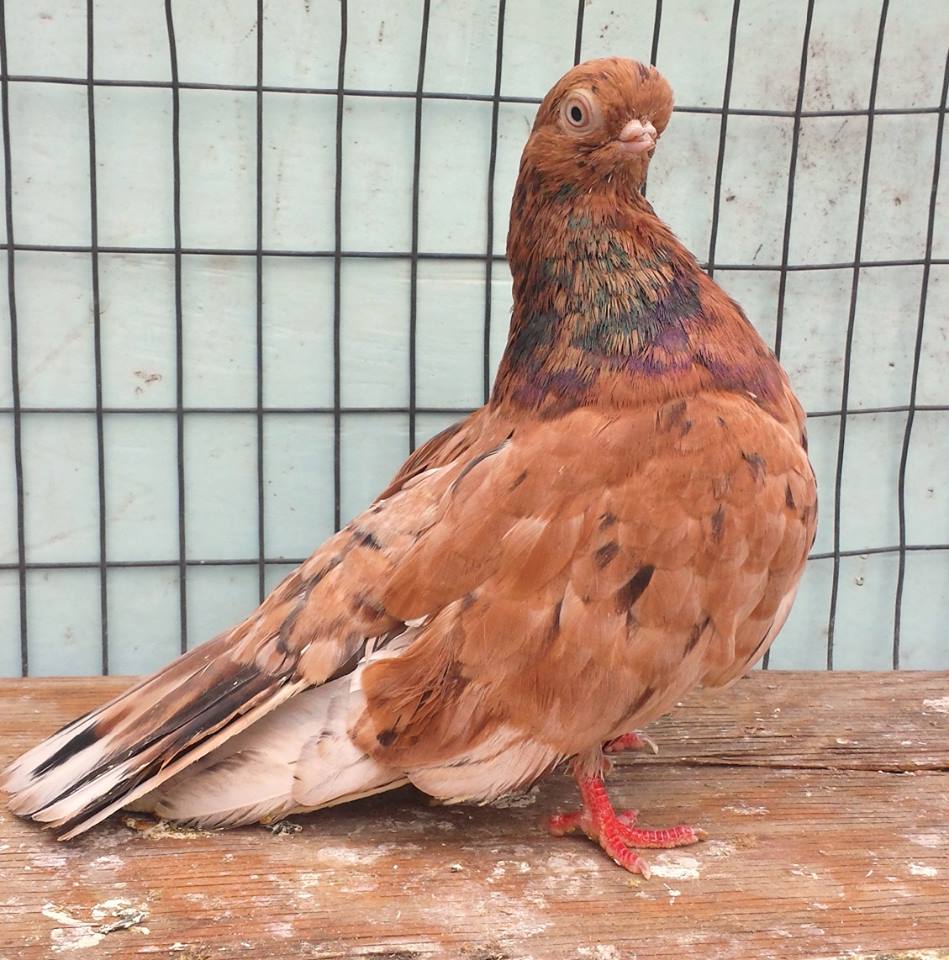
American Domestic Show Flight

The Domestic show, is a true American creation. principally and almost exclusively bred in the city of New York for many years, its bloodlines can be traced as far back as 1881. Little was known about this breed in other sections of the United States at the time.

It is believed that this breed was originally created from a cross of the Magpie and a breed known as the long faced Hollander . The American Domestic Show Flight is most unusual in that it was designed by a group of fanciers who then went on to create the breed.Show Flights are now bred all over the world as well . The American Domestic Show Flight should be 8 1/2 inches long and 8 inches tall, being thick and cobby with an erect posture ( eye over the legs ). its chest should be held high ( 4 1/2 inches wide );it's legs are short and stout ( 1 inch from the ball of the foot to the bend of the knee ) and 2 1/4 inches apart. The neck should be short and thick ( 2 1/4 inches in diameter at the middle). The bird's beak should be set in deep at the nostrils 1 inch long and 3/16 inches wide,tapering gracefully to a point, and blood  red in color. Its head must be round and prominent with the frontal being wide and overlapping the feather line of nostril. The eye , which is 1/4 inch in diameter, is set in the centre of the head. The eyes are pearly white with small black pupils.American Domestic Show Flight can be either plain headed or capped, otherwise known as crested. The American Domestic Show Flight comes in red, yellow, black,brown,dun blue and silver dun bar. It comes in solid or teager except for the barred varieties. The Domestic Show Flight also has all white flights, at least six white primaries on each wing to meet the standard


English Long-Faced Muffed Tumbler

One of the very oldest flying breeds.For centuries fanciers had performing kits of Tumblers and in the Birmingham area the muffed birds were developed by careful selection and breeding. Muffs were possible introduced by crossing the Dutch Tumbler referred to by Major in 1765.

Head :As large as possible but in proportion to the size of the body. Round in profile, raising acutely off the wattle and continuing perfectly round to the back of the crown, then merging imperceptibly with the neck. The highest point of the head is to directly over the eye. Face to be full at the cheeks and between the eyes and mouth opening, thus giving a broad appearance from the front

Eye :Bold and centrally placed between the frontal, top and back skull. Iris pearl white, pupil black as small as possible.

Eye cere : Small thread like, of fine texture. Closely feathered and well rounded, the same colour as the beak. In the case of Beards, the same colour as the upper mandible

Beak: Close fitting mandibles, wide at the base and thick in profile, giving a blunt effect and not coming to a sharp point. Both mandibles of equal thickness. Beak length from bird’s frontal to  tip to be approximately the same as its width at the base when viewed from above. The beak to be straight set i.e. parallel to the ground with the eye directly above the ball of the foot. If the line between the mandibles was extended, it would pass through the cere at the bottom of the eye

Wattle :Small, neat, fine in texture and white in colour. Close fitting so as to appear an integral part of the beak, rather than set upon it

Body : Short, cobby and wedge shaped. Chest broad, deep and well rounded, carried well forward. The general appearance is one of cobbiness and rounded contour from all points of view. A bird with a medium sized body is required.

Carriage :Sprightly, bold and jaunty. Eye carried directly over the ball of the foot and the beak held horizontally to give proper outlook.

Neck : Of medium length, slightly arched, broad at the shoulders, tapering gradually  to the throat.

Flights and Tail : Flights tightly folded. Broad, short coverts closing neatly over rump. Tail  short, closely folded and tapering slightly, allowing the flights to almost meet half an inch from the end of the tail. There should be twelve main tail flights.

Muffs :Profuse,the outer edge of each muff forming a half circle and meeting the hocks without a break.

Hocks :Profusely feathered, the points just clear of the ground.

Legs :Stout and set well apart. Of medium length.

Colour and Condition : Rich, sound and lustrous throughout. Of even shade, well extended into the roots of the quills. Full plumage and perfect physical condition is required.
Selfs: White Red Yellow Black Dun Andalusian
Barred: Blue Silver Mealy Cream.
Almond, Chequers, Grizzle and Teager (60% colour and 40% white).
Markings: Tigered(60% colour and 40% white in a random mottle type pattern, not large patches)
Saddle – Badge – Whiteside –Mottle – Rosewing – Baldhead – Beard.

Faults: All birds must wear seamless rings, preferably above the hock. Observable trimmings, dyeing, oiling, or in any way improving by artificial means must be penalised. All “faking” is subject to disqualification by the judge. Stained beaks are a serious defect and should be penalised. An unhealthy, diseased pigeon has no place in the showroom.


English Long-Faced Muffed Tumbler, Englischer Longfaced Tümmler,Culbutant Anglais à longue face,Capitombolante inglese a faccia lunga, Engelse Langvoorhoofd Tuimelaar,

English Short- Faced Tumbler

The Short Faced Tumbler is one of our oldest breeds, referred to in  Moore’s book of 1735 and the first Treatise on one breed in 1802 and has changed little since. Originally all colours except Almonds were regarded as secondary birds only. A Columbarian Society to encourage the breeding of Almonds (Ermins) was established  before 1764, the date they published the first Standard


Head: Should rise perpendicularly from the root of the beak to be large, broad, lofty and round; short as possible from front to back; also well muffed; i.e. the feathers under the eye and lower jaw should be full and curved a little upwards

Beak: Very short, fine, straight and pointed. Wattle small and fine in texture

Eye: Silvery or pearl coloured, large, bold, bright and prominent, placed well back and low down in head. Eye cere very line

Neck: Short, broad at base, tapering from shoulders to junction of beak (gullet) and well arched.

Flights and Tail:Short, proportionate and well set. Flights carried below tail.

Legs: Short

Carriage: Erect, active and dignified; head thrown well back to a line perpendicular with the feet; rump slightly raised and to walk on tips of toes when showing or playing up.

Size:As small as possible

Colours: Almond, Kite, Dun, Agate, Whole feather Agate, Mottle. Self or Whole feather in red, yellow, or black.  Colour solid to root of quill and as rich as possible.

Baldhead: Body, breast and neck, coloured. Belly, thighs, tail and the ten primary flight feathers, white. The beak should be flesh coloured for all colours

Beards: The whole bird coloured except a crescent shaped patch of white below the beak, the horns of which should extend only to the front of the eye. Stockings, flight and tail feathers, white. The beak of reds, yellows and silvers should be flesh coloured. The upper  mandibles of blues and blacks should be black, the under mandibles flesh coloured


English Short- Faced Tumbler, Englischer Shortfaced Tümmler,Culbutant Anglais à Courte Face,Capitombolante Inglese a Faccia Corta,Engelse Kortvoorhoofd Tuimelaar

Czech Baghdad

A breed perfected in Czechoslovakia that was descended from ancient Middle Eastern pigeons from such countries as Turkey , Iran and Iraq .They are a hardy and attractive breed that doesn't got to an extreme in wattle development .

The breed were imported to the United States in the early 1950's by Lynn E Hummel , still a rare breed there . It is an outstanding utility breed as well as now being an exhibition one . They were derived from crosses of local pigeons with wattle breeds; =the barb , The dragoon and the Carrier . They are plain headed and clean legged. It is somewhat similar in type and conformation to the Barb but with a longer beak and smaller eye cere. Its head is of medium length , broad and well rounded . Its beak is also of medium length and is stout, with well developed wattles, which do not attain the exaggeration of the Barb. It is somewhat between the Barb and the Dragoon in appearance . They are above average in size weighting around 600 grams , which a little heavier than the Barb. They are bread in a number of self colors; black , dun, white, red, yellow, chestnut brown and blue with or without white bars or in pencil laced or storked marked . They also come in pied and shield marked varieties. The eye color is pearl in selfs and dark in the white and pied varieties . The pencil laced colors often show a half split eye, which is part pearl and part dark. its eye cere is bright red, It is considered a breed with excellent foraging and squabbing ability.


Carneau

The Carneau is known for large size and suitability for squab production. This breed was originally raised for food. Today not many people raise pigeons for food,but instead, rather devote their attention to its sheer beauty.

The Carneau originated in northern France, extending to the Southern Belgium. The Carneau started as a field pigeon on farms and was once a free flying breed. This large pigeon has a massive head, being broad and well rounded from the wattle to the top of the skull. The furthermost forward and highest point of the head must be directly above the eye. It has Prominent, round and bright eyes with a smooth, flesh-coloured or glowing cere and a beak of medium length and stout with a V-shaped wattle. They have a very prominent frontal and well developed back skull. There should be no break where the back skull joins the neck or where the neck meets the back, it should constitute a smooth,regular curve . The neck is strong, thick and of medium length. The body is solid,compact,broad and wedge shaped and the breast must be prominent and broad. The legs must be straight and set well apart,free from any feathers, and bright red in colour. The plumage of the Carneau must be close fitting and free of noticeable other colours, They are bread in red, white, yellow,dun and black and all the colours must be deep and rich with intensive sheen.Tail should be extending approximately one inch beyond flights,clearing floor when bird is in show position - wedge shaped and nearly square at and indicative of broad back , carried in line with back and showing no evidence of having wry tail