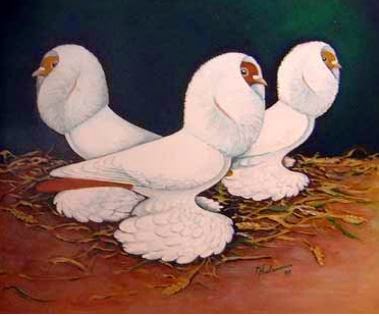
Old German Owl ( Altdeutsches Mövchen )

Origin: This breed, the Old German Owl, is the originator of the short faced German Shield Owls. The breed was again formally recognized in Germany in 1956, but the first official standard was not adopted in Europe until 1960. The Old German Owl Club adopted this standard in 1998, and it was subsequently adopted by the National Pigeon Association of America in 1999. No revisions have been made to date.

General Characteristics: Medium sized, compact, charming, gentle, active pigeon with a distinct owl character. The breed has a medium sized beak, nearly rounded head, and well developed frill. It is found in self, shield, and tail-marked varieties.

Head: Nearly round, broad, with a well arched forehead and a small full shell crest, closing with rosettes.

Eyes: Large, bright and lively bull eyes. Cere is light and delicate.

Beak: Medium length, broad, light flesh color, making an obtuse angle with the forehead. The wattle is small and undeveloped.

Neck: Short, stocky, held proudly, slanting slightly backwards and upright. The throat has a slight dewlap and a well developed frill.

Breast: Broad, well rounded and held forward prominently.

Back: Broad in the shoulders, becoming narrower toward the tail, and sloping downward.

Wings: Strong, lying close to the body, covering the back, and resting on the tail.

Tail: Held tightly together, as short as possible.

Legs: Short, shanks are scarcely visible. The feet and toes are never feathered.

Feathers: Well developed, lying tightly against the body.

Current Available Colors and Patterns: Blue, ash red, recessive red, brown, spread, checks, and bars in black, red, brown and white and dilutes of these base colors. Self white and red.

Colors and Markings: All colors are to be as smooth, clear, and saturated as possible. The body color is pure white. The shield marked variety ideally has 10 white flight feathers with colored thumb feathers. The tail marked variety is pure white except for the colored tail feathers which include a wedge-shaped portion of the back and body under the tail.


Old German Owl, Altdeutsches Mövchen, Cravaté Allemand ancien, Vecchio cravattato tedesco, Oud-Duitse Meeuw, 

Schmalkalden Moorhead ( Schmalkaldener Mohrenkopf )

Bred originally from the jacobins and Long Muffed Moorhead Pigeons, It was known as a breed as early as 1895 in Thuringer and Saxon Mountain Areas , A strongly built,long field pigeon type with a horizontal body underline. Full rich ' mane ' feathering around the neck and ' hood ' feathering on the head. Also thick, full and broad muffs.


Head :- Rounded ( arched ) . The forehead broad, and slightly rising front.

Eye: Dark with small and fine eye-cere. Blacks and Blues in dark colour, Reds and Yellows in pale colour.

Beak: medium length . Black coloured for blacks and blues. Light coloured for Reds and Yellows. Wattle is small, flat , fine in texture and white powdered.

Neck : Relative long and strong. The feather structure is full and strong and starts from a more or less elongated parting on each side of the lower neck. The structure consists of the fine long feathers spreading forwards to form the 'chain' backwards to the 'mane' and upwards to form a ' cowl ' around the head, not obstructing the bird's sight. Forehead and beak should be fully visible.

Breast: Deep and well rounded .

Wings : Long, closed and held on the tail, but not crossing.

Tail : Long and well closed.


South German White-tail Pigeon

                                                                                                                                                   
The South German White tail is a medium sized compact clean-legged field pigeon, with almost horizontal posture with a well developed shell-crest.The head is well rounded and appearing broad with a well developed shell-crest. The head is well rounded and appearing broad with a well developed forehead; the shell-crest is held clear from the skull and set fairly high with well developed rosettes either side.


The eye is orange colour and the eye-cere is fine/narrow; for reds and yellows, pale to reddish colour and for all other colours,dark. The beak is medium length, for reds and yellows pale colour for all other colours the beak is black , the beak-cere is small, smooth and white powdered. The feathering is smooth and carried close to the body, this gives the impression it is smaller and slimmer than some of the other South German Breeds bit in the hand the impression is of a compact and firmly built pigeon.The ground colour is 'self'' coloured with exception of a white spot or 'snip' that should not be too large or too small and the 12 white tail feathers and the upper tail-coverts.This sounds easy, but to accomplish it is very difficult, as the under tail-covers must be coloured, also the size of the forehead spot is related to the 'sound' colouring of the belly and under tail-coverts is rarely correct. The colour of the belly and under tail-cover is a good guide to the quality of a bird,


Red Turtle Dove


Photo By : Alder


Photo By : Sharad Agrawal

Prachen Kanik

Its a Breed from Czech Republic , The area of their origin is the province in South Bohemia named Prachen and the  name Kanik comes from a local owl pigeon . This breed is an elegant, strongly built,stocky pigeon that still has the type of the field pigeon.The stance is almost horizontal and medium high. The body not too long , the wings are broad, carried tight against the body , the tips resting on the tail showing the attractive shield marking.

The eyes are orange to ruby red and fiery, birds with brown feather colour have paler eyes.The eye-cere is of a fine texture, colour is pink to red, this holds for all colour varieties.The basic markings of the Prachen Kanik is the strasser marking, but with some extras: The prachen Kanik has white flights, minimum seven and maximum ten. A difference of no more than 2 white flights between both wings is allowed.'Slip' flights is not a major fault, even important in the breeding, because the white colour   always has a tendency to spread. The back of the Prachen Kanik is white, with a clean separation at the vent. An important breed characteristic is the medium size white spot on the forehead starting at the beak cere. The size of the spot may vary from small pea-size to a slightly elongated marking up to 1.5 cm long,it should not be too large or too broad.